
Type 1 diabetes (T1D) is still often discovered at the worst possible moment.
Not when the disease begins, and not when the immune system first starts attacking the insulin-producing cells of the pancreas, but later, when symptoms have escalated, blood glucose is dangerously high, and a child, partner, or friend ends up in the emergency room with diabetic ketoacidosis, or DKA, a life-threatening metabolic crisis.
This is how many families first encounter the disease: suddenly, frightened, and with no time to prepare.
Yet T1D begins much earlier, sometimes years before symptoms appear, and in many people, it can be detected during this silent phase. But the gap between what science can see and what patients still experience is now one of the most important opportunities in T1D. Increasingly, the challenge is to connect early disease research with the systems that can act on that knowledge.
Making early detection of T1D a reality is a shared endeavor, bringing together researchers, clinicians, health systems, advocacy organizations and industry.
Sanofi is part of that effort, advancing the science around early-stage disease and developing strategies to find and support people before the disease fully takes hold.

A Disease That Starts Long Before Symptoms
In type 1 diabetes, the immune system turns against the beta cells in the pancreas, which normally produce insulin. Over time, those cells are damaged or destroyed, and the body gradually loses its ability to regulate blood glucose.
Alessandro Sorrentino
Global Medical Head for Autoimmune Type 1 Diabetes and Cardiovascular and Metabolism
For years, T1D was understood mainly through its clinical stage: high blood glucose, clear symptoms, and the need for insulin treatment.
That shift began taking shape in the 1970s and 1980s, as researchers identified Type 1 diabetes-related autoantibodies: early markers in the blood that can appear before symptoms, signaling that the disease process has already begun. Seen this way, diagnosis was no longer the beginning of the story. It was one moment in a disease that could unfold silently over time.
The staging framework, formalized in 2015, gave that insight a clinical structure: Stage 1 – autoantibodies present, blood glucose still normal; Stage 2 – glucose regulation begins to change, but there are still no symptoms; Stage 3 – clinical disease and insulin dependence; Stage 4 – long-lasting T1D.
The staging framework made clear that the period before clinical diagnosis is itself part of the disease, and potentially a time in which to act. Turning this understanding into clinical practice, however, requires a consistent approach to finding and following people with early-stage disease. Breakthrough T1D has led two major international consensus efforts: the International Consensus Guidance on Screening for Early-Stage Type 1 Diabetes and the International Consensus Guidance for Monitoring People with Early-Stage Type 1 Diabetes.
“For over 50 years, Breakthrough T1D (formerly JDRF) has been leading global efforts in research and advocacy to drive the breakthroughs that could one day allow us to stop progression of T1D before a person needs insulin, with the future aim of ultimately preventing type 1 diabetes,” Amara Ogbonnaya-Whittlesey, MD, Breakthrough T1D Director of Medical Affairs says. “We convened the leading experts across the world to develop practical tools to facilitate the implementation of screening in the clinical setting for the broader population. Identifying people with T1D early, through screening and early detection, is the first step in changing the course of T1D by providing a window to intervene.”
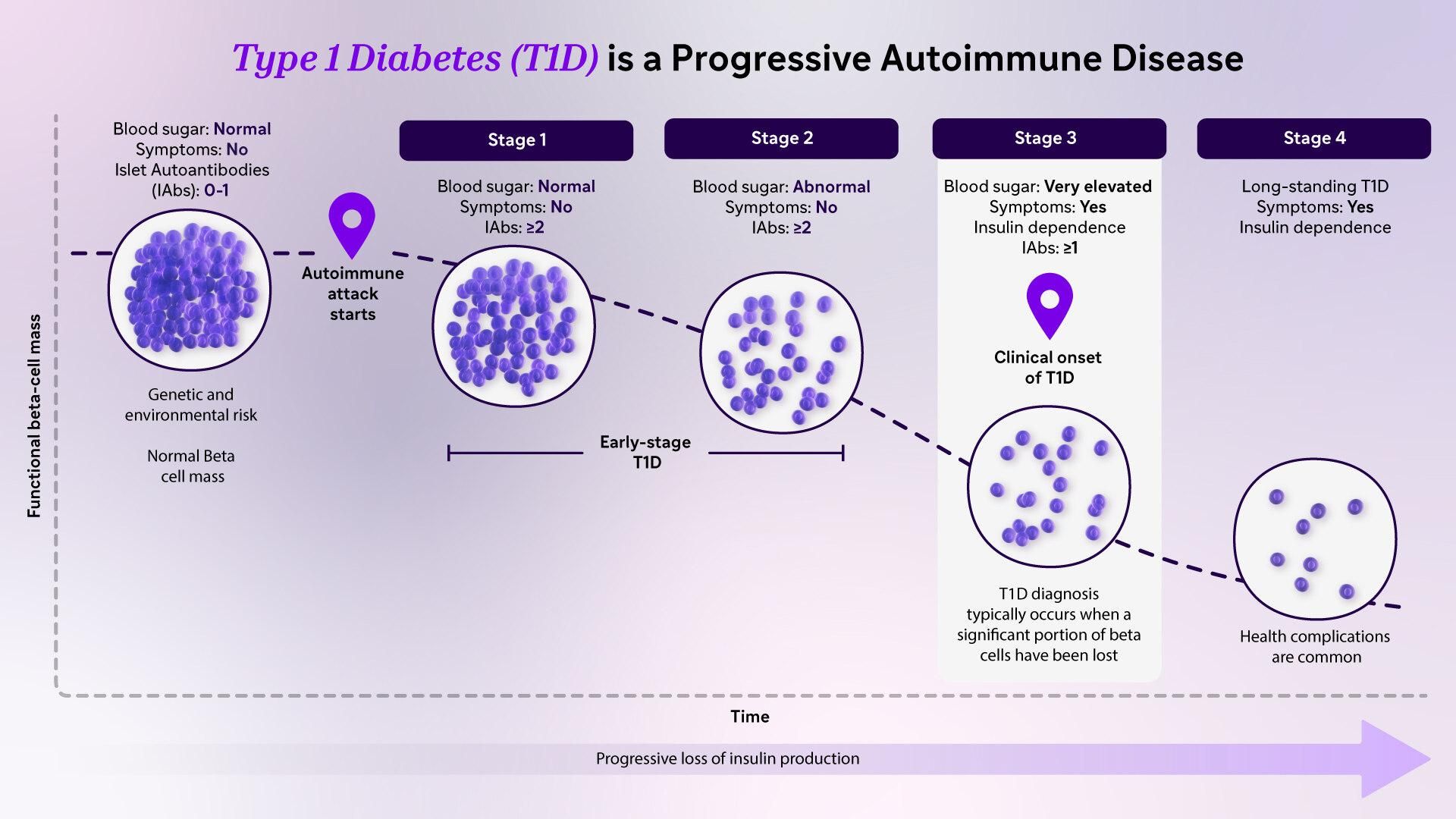
T1D is a progressive autoimmune disease that can be identified and staged long before clinical symptoms appear. Identifying individuals with T1D before they are symptomatic can help change the typical trajectory of disease. With information from Breakthrough T1D.
Opening the Window
Understanding T1D as a staged disease helps inform how researchers think about when to intervene.
By Stage 2, beta-cell function is already beginning to change measurably, even though the person still feels well. Mark explains, “T1D progression means your body can’t control blood glucose as well as it should. You probably wouldn’t notice. But we could challenge your body with glucose and detect that decrease in control.”
This makes Stage 2 a clinically meaningful point in the disease process, shifting the focus from managing symptoms to whether the disease can be slowed or interrupted.
If intervention is possible earlier in the disease course, finding people earlier becomes increasingly important.
At Sanofi, data and computational tools are helping researchers model disease progression, identify disease patterns, find new therapeutic targets, and design more efficient clinical trials.
From Replacing Insulin to Changing the Disease Course
For most of the last century, even when clinicians understood what was happening, there was little they could do beyond replace the insulin that the damaged beta cells no longer produced.
Disease-modifying approaches in T1D are built around a different idea: not only treating the consequences of the immune attack on the beta cells but intervening in the process itself.
For a child at Stage 2, delaying progression can mean more time before insulin management becomes part of daily life, more time for ordinary routines, and more time before a chronic diagnosis begins to shape everyday decisions. Sanofi’s immunoscience research is looking even earlier. Mark describes a stage-specific approach, matching interventions to different points along the disease arc. Stage 2 is the current clinical focus, while Stage 1, when beta-cell reserves are larger, is the next frontier.
“The prize for the next generation,” Mark says, “is a truly preventative approach, where you wouldn’t even have the autoantibodies develop.”
What “Earlier” Means in Practice
A diagnosis via DKA is a dangerous and deeply disorienting way to find out that your life has changed. It’s not the point at which people want to start their journey into a lifelong disease.
Matthew Mailman
Global Early Detection Strategy Lead for T1D
Earlier detection cannot remove the burden of T1D, but it can change how people first encounter the disease. Matt describes this as a “soft landing,” giving people time to understand what is happening, connect with specialist care, begin monitoring, and prepare for a “new normal.”
Mark describes what delaying disease progression could mean for families. For a child at Stage 2 whose disease progression is delayed, everyday life may remain ordinary for longer. And for a parent who has already watched a child go through diabetes-related crisis and the vigilance that follows, the value of that time hardly needs explaining.
Earlier Detection Is Only Useful if It Leads Somewhere
There is already a blood test that can detect early-stage disease. The challenge is what happens after that test.
“A positive test result should lead somewhere constructive,” says Alessandro. This means explanation, referral, monitoring, and a clear plan for care. Families need to understand what the result means and what happens next, while clinicians need to know how to interpret it and where to refer someone.
This is where the consensus guidance can help. A consistent, stepwise approach is not as common as we’d hope. Most people with early type 1 diabetes are seen in primary care, not specialized clinics, and they usually feel well. Earlier-stage disease is still not something general practitioners are aware of and are routinely evaluating for.
Amara Ogbonnaya-Whittlesey
MD, Breakthrough T1D Director of Medical Affairs
Behind those clinical gaps lie structural ones. Tests need to be authorized, affordable, and scalable. Guidelines need to be endorsed by medical societies. Referral networks need to connect a positive result with timely specialist follow-up, explains Matt. Done well, that conversation can replace confusion with clarity. Done poorly, it can leave families with anxiety and no path forward, cautions Amara.
A blood test, on its own, is not enough. The system of care around it must be prepared to carry the result forward into constructive action.
Building the Detection Ecosystem
In early 2026, the European EDENT1FI program reached 100,000 children screened across multiple European countries. The ELSA Study in the UK had screened more than 17,000 children by January 2026, helping show how screening can connect to monitoring before a crisis occurs.
As Alessandro explains, these programs are helping to build the clinical utility and health-economic evidence that health systems need to consider broader screening. They are also helping refine care pathways and providing insights into how families respond to early detection.
For now, screening is most straightforward in higher-risk groups, including first-degree relatives of people with T1D and people with related autoimmune conditions such as celiac disease or autoimmune thyroid disease. But because most people who develop T1D have no known family history of the disease, screening needs to reach beyond these higher-risk groups.
Italy has introduced a national approach to screening children for both type 1 diabetes and celiac disease. Across Europe, the conversation is shifting from whether early-stage type 1 diabetes can be detected to how screening and monitoring could be implemented more broadly in practice. Predictive AI models and polygenic risk scores are also being developed to make general population screening more targeted. In the future, these approaches could contribute to newborn screening strategies, helping identify high-risk children from birth.
Catching the Disease Before It Catches the Patient
Today, earlier detection and earlier intervention go hand in hand. This is the logic behind Sanofi’s dual approach: aspiring to move the intervention window earlier through immunoscience while also working to make that window reachable through detection, screening, and care pathways.
The science is moving faster than the systems around it. Closing that gap means turning earlier knowledge into earlier action, with the goal of reaching more people before symptoms appear.
- Mark Peakman has retired from Sanofi.