
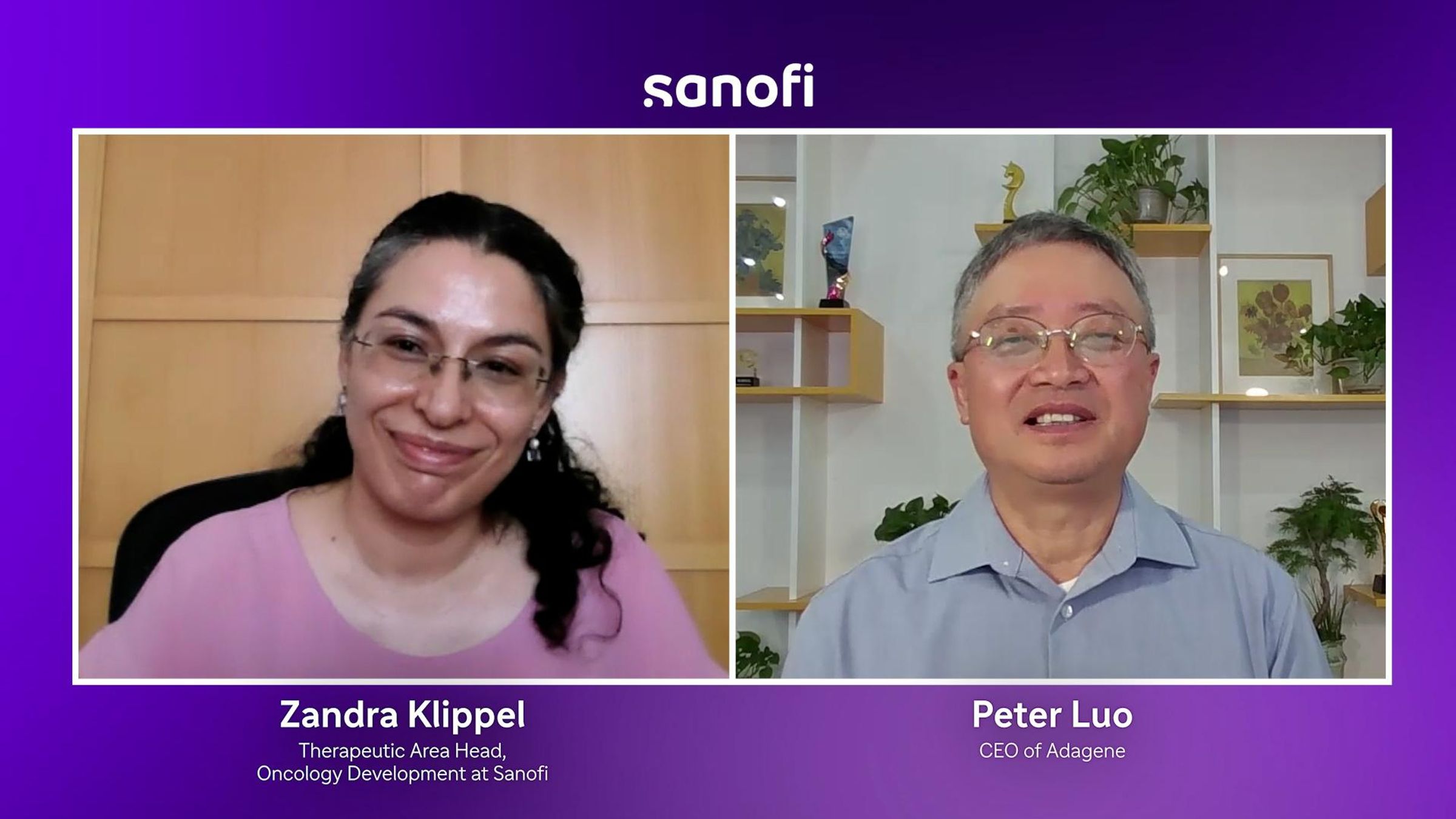
Welcome to the latest episode of our Partner Spotlight series, where we explore how Sanofi is collaborating with innovative companies to transform the future of medicine. In this episode, Zandra Klippel, Therapeutic Area Head of Oncology Development at Sanofi, is joined by Peter Luo, Ph.D., Chairman, CEO & President of R&D at Adagene, a clinical-stage biotechnology company developing antibody-based cancer immunotherapies with a focus on precision targeting. Their conversation explores the evolution of cancer immunotherapy, the potential of conditional antibody technologies, and how strategic partnerships can help advance innovation in oncology.
As cancer immunotherapy continues to evolve, researchers are increasingly focused on finding more precise ways to harness the immune system against cancer while limiting unwanted effects on normal tissues. Conditional antibody technologies offer one approach to this challenge by remaining inactive in normal tissues and becoming activated in the tumor microenvironment, where they can target cancer cells.
Against this backdrop, Dr. Klippel and Dr. Luo discuss how greater precision, a deeper understanding of the tumor microenvironment, and more collaborative approaches to research could help shape the future of cancer immunotherapy.
Together, Sanofi and Adagene are bringing complementary scientific and development strengths to cancer research, with the goal of translating promising science into potential therapies that can reach patients on a global scale.
Moving Toward More Precise Immunotherapies
“Early immunotherapies demonstrated the power of activating the entire immune system against cancer,” Dr. Klippel explained. But the field has evolved, with researchers turning their attention to greater precision. “There’s growing emphasis on matching the patient with the right target and the right mechanism.”
Rather than broadly activating the immune system, scientists are working to better understand the biological pathways involved in cancer and how immunotherapies can act more selectively. One such approach is the use of conditional antibody technologies.
“Conditional antibodies are designed to activate where the disease is, not everywhere the drug goes,” Dr. Luo explained.
Some targets can be difficult to engage because they are also present on normal tissues, creating the potential for unwanted side effects. By making the activity of an antibody more dependent on conditions within the tumor microenvironment, conditional approaches aim to selectively fight abnormal cancer cells while helping spare non-tumor tissue.
Understanding the Tumor Microenvironment
Another important area of research is focused on the tumor microenvironment, the complex setting surrounding a tumor. “The tumor microenvironment plays a critical role in determining how these cancers grow and how they respond to treatment,” Dr. Klippel said.
Researchers are increasingly exploring how to influence this environment to help therapies work more effectively. This requires looking beyond the tumor itself and understanding the surrounding biological conditions that can support or inhibit an immune response.
Combined with advances in precision targeting, this deeper understanding of tumor biology could help inform the next generation of cancer immunotherapy.
The Power of Complementary Strengths
Both leaders emphasized that advancing increasingly complex science requires strategic collaboration, drawing on different capabilities and perspectives across organizations.
For Dr. Luo, the strongest partnerships begin with complementary expertise.
"Biotechnology companies can bring breakthrough science and emerging technologies", Dr. Luo explained, "while larger pharmaceutical organizations can contribute the capabilities needed to advance clinical development at scale."
Dr. Klippel similarly emphasized the value of bringing together organizations with diverse perspectives to approach complex scientific challenges from different angles.
As the science has evolved, so too have the models used to support these collaborations. Dr. Klippel noted that partnership structures have become more flexible and adaptable, with an emphasis on supporting promising science while creating mutual value over time.
Bringing these strengths together creates a powerful model for translating scientific innovation into potential therapies that can ultimately reach patients around the world.
I believe the best partnerships are always built on complementary strengths.

Peter Luo
The most meaningful breakthroughs often happen when organizations with different strengths come together and tackle these complex scientific challenges through different angles

Zandra Klippel
Looking Ahead
As oncology research continues to evolve, new avenues are opening for cancer immunotherapy. This paves a promising path forward for translating newfound insights into approaches that can address the complexity of cancer while continuing to meet the needs of patients.
For Sanofi and Adagene, continued collaboration and a shared commitment to innovation offer a strong opportunity to build on these developments and further advance tumor-targeted immunotherapies. Combining breakthrough science with deep development expertise will be essential to translating promising approaches into transformative potential treatments for patients.
If you missed our previous Partner Spotlight focused on the next generation of immune-mediated disease treatments, please click here. Stay tuned for our next Partner Spotlight, where we’ll explore how collaboration is helping advance the next generation of genetic medicines.