In part one of our rare disease mini-series, we explored how Sanofi is redesigning rare disease research through Mendelian and Immunoscience approaches. Now, we share an overview of the cutting-edge technologies, from advanced delivery systems to AI-driven insights, that are making these breakthroughs possible.
Pablo Sardi’s scientific mission began with a stark realization: rare diseases typically existed in the shadows, often starved of resources and hope. Developing treatments required more than good intentions—it demanded a deep understanding of what was missing at the molecular level and the tools to fix it.
Guided by this vision, Sardi, the Global Head of Rare Diseases at Sanofi, immersed himself in decoding the biological mechanisms driving disease progression, determined to bring solutions to a field that is long overlooked. Unlike traditional medicine, which often focuses on addressing symptoms, he was captivated by precision medicine, an approach that dives deep into the molecular roots of diseases. It works by identifying faulty mechanisms and designing interventions that address mechanistic pathways that drive disease, aiming to correct problems that are upstream of symptoms.
A Mission to Decode Rare Diseases
Now, as a champion of research in rare conditions, Pablo sets the direction and identifies opportunities and technologies where the company can invest resources to develop treatment options that can benefit thousands of patients.
This curiosity to understand the mechanism of disease is not just a quirk as a Global head of rare diseases at Sanofi. “We have a joke at home about my nerdiness and how my kids have inherited it.” Still, finding a new disease mechanism is a source of excitement for him. “Such research can open up new doors,” he says, paving the way to better understand the biology of a disease, explore approaches that might help mitigate its impacts and engineer strategies with a precise intervention.
Though his work takes place on a microscopic scale, Sardi describes the excitement of uncovering new disease mechanisms and engineering targeted therapeutic approaches as nothing short of cosmic. “Each breakthrough that our team makes feels like what astronauts might experience during the landing missions to the moon, or sending the first probe to Mars,” he says. “We’re exploring unknown territory in rare diseases, with goals of developing transformative approaches that are urgently needed.”
While the primary goal of Sanofi’s rare disease research is to develop treatments, the R&D process often delivers much more than just a therapy for a single condition. It deepens our understanding of underlying biological processes and advances the technologies that make future breakthroughs possible – in rare diseases and beyond.
Technology Inspired by the Body’s Natural Processes
Researchers often look to the body’s own biology for inspiration when developing new therapies. One exciting example is how scientists are learning to piggyback on natural transport systems to deliver medicines into the brain, a place that researchers find notoriously hard to reach.
The blood-brain barrier (BBB) is a protective layer that shields the brain from harmful substances in the bloodstream. But this shield also makes it difficult for most drugs to get through to the brain. Still, the brain has its own way of letting in essential nutrients, like iron or amino acids, which enter through specialized transporters. At Sanofi, researchers are tapping into this very pathway as a “shuttle” mechanism to cross the BBB.
A major goal of mine is to unlock tissue-specific delivery for therapeutics to provide as many patients as possible with both effective and targeted treatments.

Pablo Sardi
Global Head of Rare Diseases Research
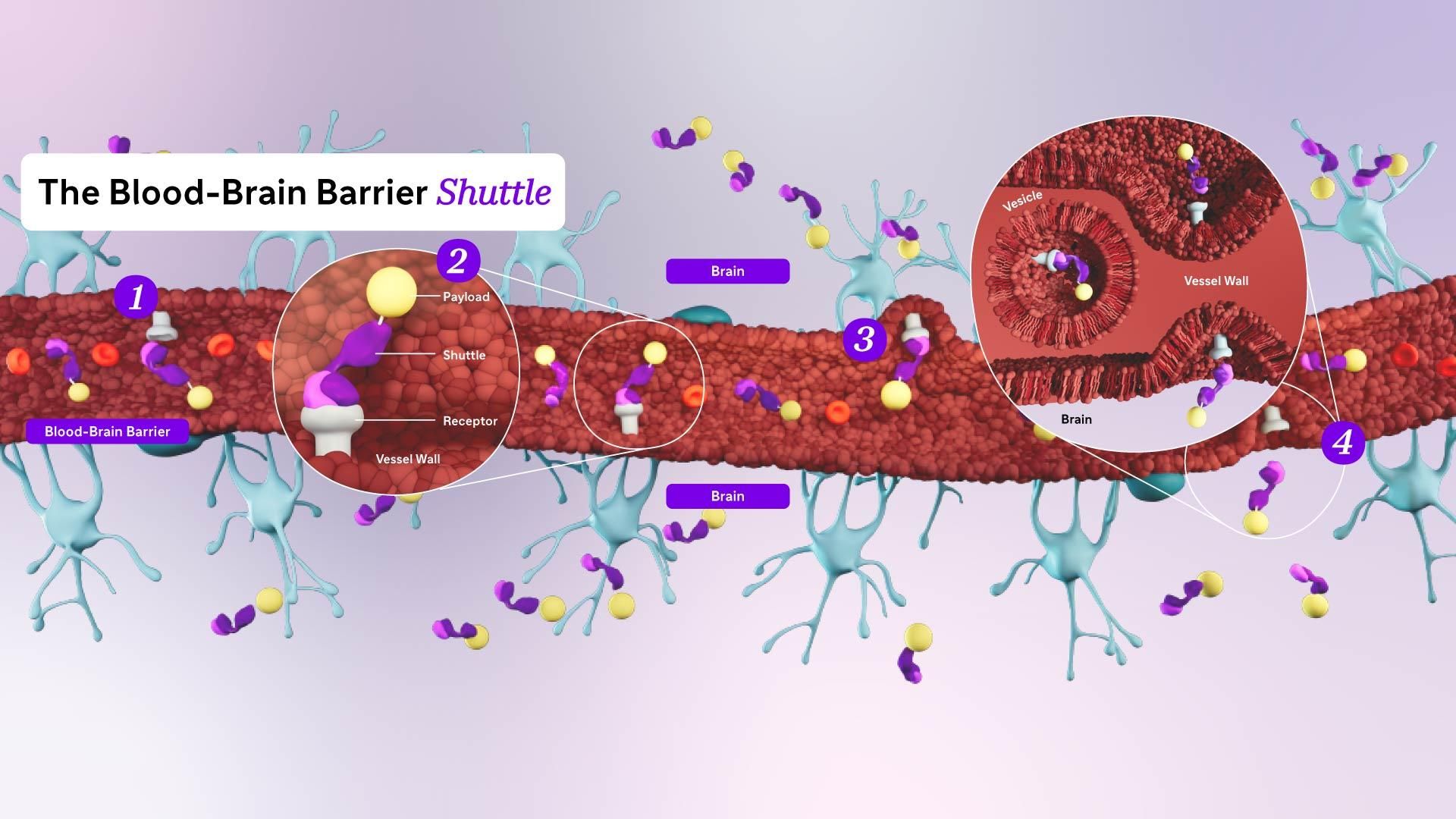
An overview of how Sanofi’s Blood-Brain Barrier (BBB) Shuttle delivers a medicine into the brain. Step 1. The shuttle molecule (purple), connected to a therapeutic payload/medicine (yellow), moves through the blood vessels of the brain. Step 2. The shuttle binds to a receptor on the wall of the blood vessel. Step 3. The shuttle is internalized inside a specialized structure (vesicle) and transported from one side of the blood vessel wall to the opposite side. Step 4. The vesicle releases the shuttle molecule on the other side of the BBB, delivering the payload to brain, where it can have an impact on cells like neurons (blue).
In one example (above graphic), an antibody is engineered to bind to one of the specialized transporters found on the wall of a blood vessel in the brain. That specialized antibody (purple) is the “carrier” of the shuttle. It also contains a “payload” – a drug (yellow), intended to act inside the brain, on cells like neurons. Together, this antibody-drug shuttle binds to the nutrient transporter (grey) on the vessel wall, where it’s engulfed and transported across the BBB in a specialized vesicle, just as a nutrient would be. Once inside the brain, the shuttle is released and the drug can reach its intended target. By mimicking a natural process, our BBB shuttle opens the door to potential treatments for a wide range of rare neurological diseases.
Sanofi’s shuttle is designed with modularity in mind: the carrier and payload are interchangeable. Depending on the target cell or tissue, the receptors used to cross a barrier, or other biological factors, different carrier molecules can be used as the biology dictates. Likewise, different therapeutics can be used as payloads, to deliver different kinds of drugs, depending on the disease. Our approach focuses on optimizing both transport efficiency and payload flexibility, enabling delivery of a wider range of therapeutic options.
“This is just the beginning,” says Sardi. What began as a strategy inspired by nutrient delivery may expand to transporting a range of molecules. “Our researchers are expanding these strategies beyond the brain, exploring ways to deliver therapeutics to muscles and other specialized tissues.” Gene-editing technologies, where we want to precisely correct disease-causing mutations at their source, are another exciting frontier where these new delivery mechanisms could be used – enabling us to reach cellular locations that were previously difficult to access.
These advances are laying the foundation for treatments that were once unimaginable. For Sanofi, every breakthrough in rare diseases not only brings hope to patients but also builds a scientific toolbox—unlocking knowledge and technologies that will accelerate discoveries for years to come.
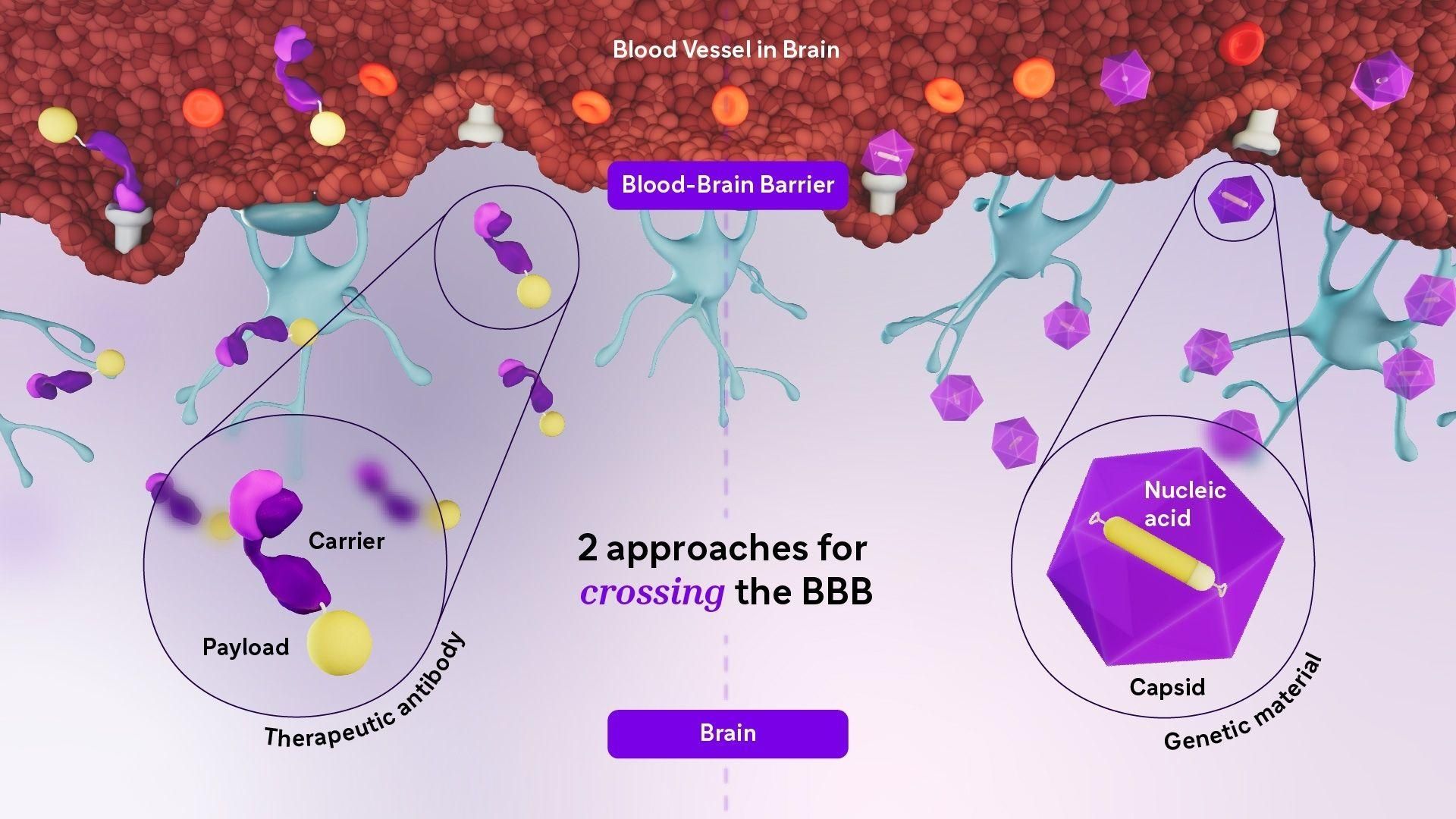
Different mechanisms can be used to cross the blood-brain barrier (BBB). A protein shuttle can deliver therapeutic protein or antibodies (left, in yellow). An AI-engineered, adeno-associated virus (AAV) capsid can deliver nucleic acid payloads (right, in yellow).
Connecting Hidden Dots and Optimizing Design: AI in Rare Disease R&D
Specialized, antibody-based shuttles aren’t the only way we’re aiming to cross the BBB. Oftentimes, scientists use adeno-associated viruses (AAVs) as tiny delivery vehicles to carry healthy genes into the body. However, one of the biggest challenges has been getting these viruses to reach specific tissues, like the muscle or brain, and to escape the body’s natural defense systems.
To overcome this, Sanofi scientists are using Artificial Intelligence (AI) to design better viral “shells,” called capsids. Similar to antibody-based shuttles, these engineered capsids can help the genetic material cross the BBB to target precise cells in the brain and bypass immune responses, for example, with the goal of delivering therapies exactly where they are needed. These AI-designed capsids are opening up new possibilities that were previously out of reach.
Sanofi researchers are also using AI to connect vast datasets and uncover complex patterns in rare diseases. They have recently published research on AI tools that have accelerated the identification of disease-related mutations. “Traditional screening techniques would have needed decades to sort through that number of mutations,” Sardi says. AI is also having transformational impacts in other areas of rare disease research, including finding new drug targets, optimizing molecules, and generating novel hypotheses from complex data.
This AI-powered identification of new mutations and patterns is also prompting our scientists to shift their perspectives on the biology behind some conditions. In rare diseases, many different genetic mutations might cause similar symptoms or disrupt similar biological functions. Now, AI is helping to bundle together different genetic signals that affect the same biological pathway, helping to unravel the common patterns between them and suggest potential points of intervention. “If you look at them from a clinician’s perspective, there are different diseases. But they might have the same pathway affected,” Pablo adds. “A new medicine targeting that shared pathway could help more types of people.”
Challenges and Excitement Ahead
Rare diseases are incredibly complex. Patient populations can be hard to find and define. But despite the technical and logistical challenges, Sardi’s passion for the field remains unshaken.
Another critical leap for the field will come from detecting disease much earlier in life. That’s why researchers are pushing for more advanced newborn screening programs. “Once you find the right molecules, you need to identify patients as soon as possible,” he adds.
“Figuring out what is wrong and engineering a molecular solution is just incredibly complex.” Still, he says, “nature has given us these intricate biological mechanisms that sometimes go rogue. We’re trying to trick those systems into returning to a healthier state.”
Explore More
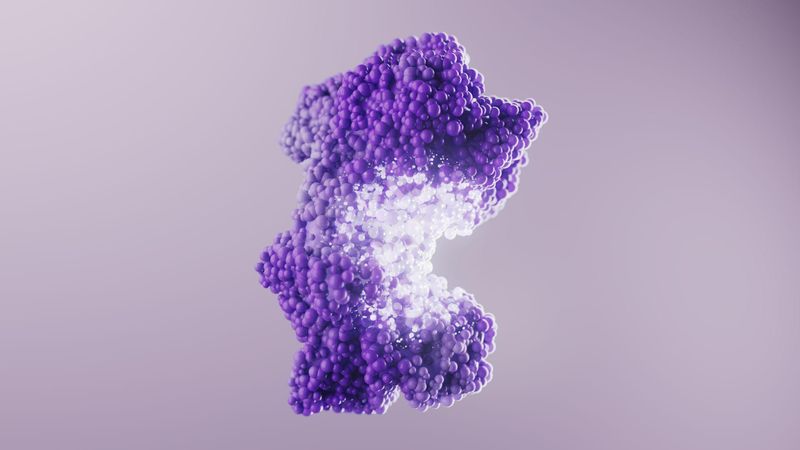
Rare Diseases Research & Development
How We’re Redesigning Rare Disease Research