
In drug development, multi-specific molecules help us address complex biology by targeting more than one biological process at a time. At Sanofi, we are taking several approaches to developing new medicines that feature multi-specific targeting. A previous installment of our multi-specific targeting series looked at how nanobodies can address multiple biological processes in one molecule. In this story, we examine Sanofi’s Dual Targeting Library approach to drug development.
For much of modern drug discovery, precision has meant narrowing the focus: Find the target. Understand the pathway. Design a molecule that acts as specifically as possible. The 'magic bullet' idea, attributed to the German physician Paul Ehrlich more than a century ago, still shapes how many medicines are discovered: the more precisely a drug hits its intended target, the cleaner the effect is expected to be, with fewer unintended effects.
This logic has transformed medicine. But it also has limits.
Nature is complex. Biology rarely works through one target at a time. Cells have redundancies and pathways have backups. A signal that looks clear in isolation can behave differently inside a living system. A highly specific drug may do exactly what it was designed to do and still run into the ceiling of what one target can achieve, given those complex redundancies.
This is why bispecific antibodies — molecules that bind two targets simultaneously — have become such an important frontier in drug development. In principle, a bispecific molecule can bring together two biological effects, impacting two pathways, or even two different cell types in a single molecule.
“Bispecifics are not new. But how Sanofi is finding them is,” says Paolo Meoni, Senior Distinguished Scientist and Project Head at Sanofi.
The Problem With Prediction
When bispecific development programs start from existing knowledge — the same published literature, the same established targets, the same conversations circulating through the field — they can arrive at the same places. “You start to see overlap in what’s moving through pharmaceutical company pipelines,” Paolo says. A deeper challenge sits underneath: even when scientists do venture into new territory, two targets do not simply add up to one predictable answer. “You think you know what happens when you modulate target A and target B individually,” says Paolo. “But predicting how they will act together is much harder than it sounds.”
Paolo likens it to introducing two people. You can know them very well individually, but you cannot fully predict what will happen when you put them in the same room together. Something entirely new emerges from the interaction itself.
In biology, this interaction can include the spatial relationships between cells, local tissue organization, signaling interactions between pathways – ripple effects that were not apparent from studying either target in isolation. Some of those surprises turn out to be useful, while others become scientific dead ends. The fundamental reality, Paolo says, is that you cannot know until you test.
Sanofi’s Dual Targeting Library 2.0, or DTL 2.0, is built around that premise of unpredictability: combining single-targeting molecules in an unbiased way and evaluating outcomes. The goal is to reveal new, hard-to-predict bispecific combinations that can advance into development.
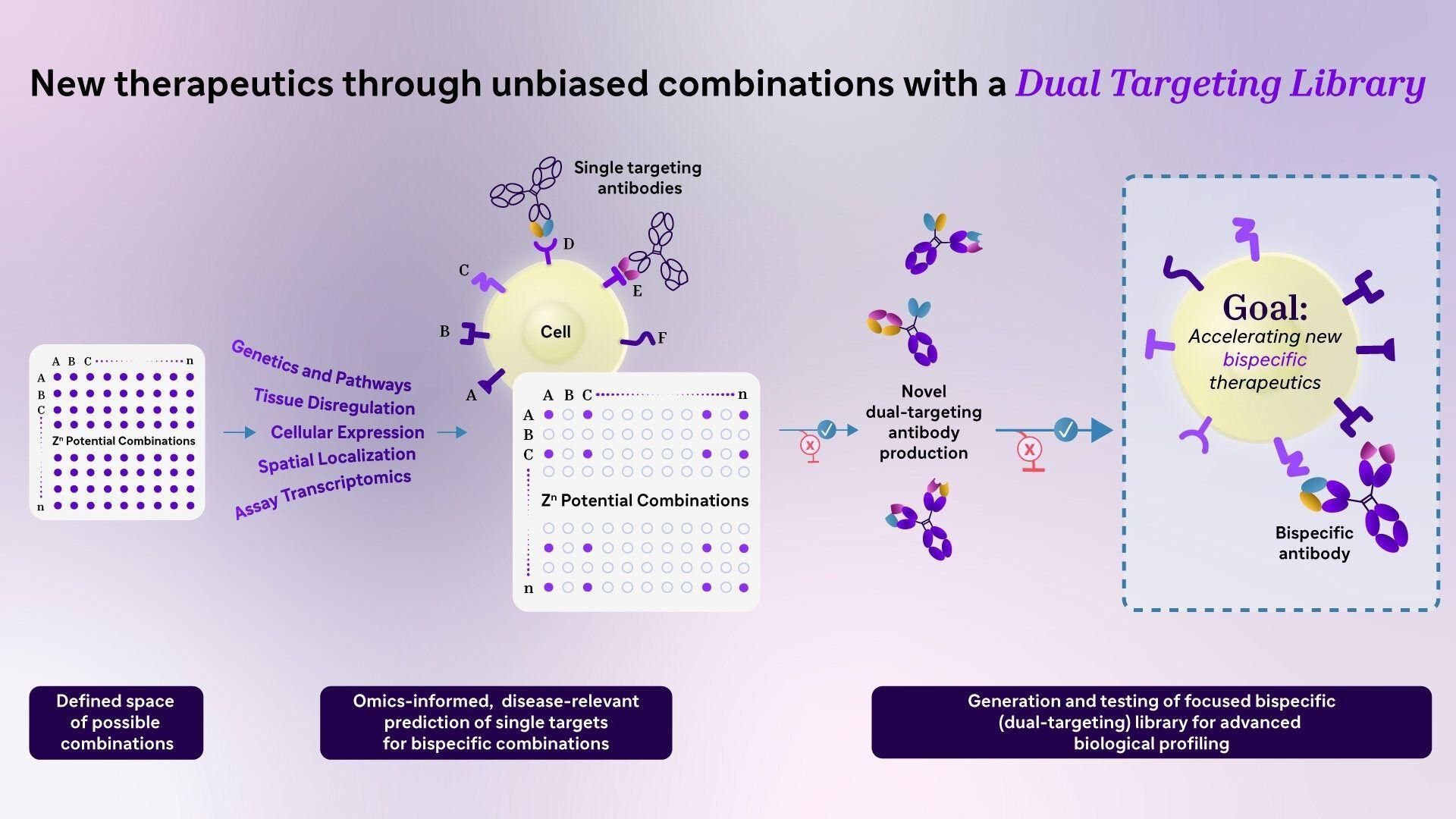
An overview of the Dual Targeting Library process. The process starts with the identification of the most biologically- and disease-relevant single targets within all the proteins expressed by cells – a list of things that could be combined. Selected single-targeting molecules are then assembled into bispecific molecules. Bispecific molecules producing positive readouts are then confirmed through additional testing. This process produces a focused library of bispecific molecules, with the goal of finding novel therapeutics.
Letting the Data Show Us What Matters
“You can’t just imagine bispecifics.” Paolo says plainly. “You have to generate the relevant data and then allow that data to define the best combination.”
In practice, this means building libraries of bispecific molecules by physically pairing monospecific (single-targeting) antibodies and nanobodies in many different combinations, then testing those combinations in disease-relevant biological systems to see what happens. In this sense, DTL 2.0 functions more like a hypothesis-generating engine, using biological data to decide which combinations deserve deeper investigation.
Computational models developed by Sanofi’s “Target, Diseases and System Biology” (TDSB) team help narrow an initial list that might include hundreds of possible targets down to a workable set. But once that filtering is done, prior assumptions are deliberately set aside. The pairing of two molecules does not have to be justified by a hypothesis about why they should work together. It can be justified by a simpler question: what happens when they do?
"You let the data define what is the best combination," Paolo says. The work then shifts from prediction to interpretation: understanding why a combination produced an effect, whether that effect is useful, and what it might mean for disease biology.
Current DTL 2.0 programs are testing this unbiased combination approach across several biological contexts, including targeting of tumor cells, regulation of immune cell responses in inflammation, interactions between immune and non-immune cells, and inflammatory processes in the eye. In each therapeutic area, scientists are exploring what happens when molecules are combined, to reveal a novel pairing that can have a positive, synergistic effect on a process or a disease.
Why One Readout Is Not Enough
Our approach depends on assays that are complex enough to reflect real disease biology, but controlled enough to produce interpretable signals.
T cells and B cells, for example, are known to interact in autoimmune diseases. A bispecific combination might reduce immunoglobulin production, a potentially desired effect. But that same combination might also cause T cells to proliferate, which could become a liability in inflammatory conditions. With a single readout, you might only see one side of the biological story. Through further profiling with several readouts (secretion of soluble factors, cell proliferation, activation status), the picture sharpens, and helps scientists understand what combinations are more likely to have therapeutic utility.
The same logic applies to fibroblasts, which can contribute to both inflammation and fibrosis. A bispecific antibody that affects inflammatory signals, but not extracellular matrix production, has a very different therapeutic profile from one that affects both. Multiple readouts help distinguish those possibilities before a program goes further.
Scientists working with DTL 2.0 are looking for both activity and context: the type of activity, the strength of the effect, and whether a combination creates benefits or liabilities in the relevant biological setting. A positive signal in an assay, Paolo is careful to note, is only a beginning. “There is still a significant amount of work to turn an early signal into a therapeutic, but the DTL approach helps us to better understand the details of an early signal.”
From Thousands of Combinations to Meaningful Signals
The scale of DTL 2.0 is significant. Current efforts involve testing roughly one to two thousand combinations, with an ambition to expand toward five to ten thousand as assay capacity, miniaturization, and analytical methods improve.
The complexity compounds quickly: more targets mean exponentially more combinations. More readouts per combination mean more data than any human team can interpret by inspection alone. Biostatistics provides the first layer of triage, identifying combinations that show potentially useful effects. Promising hits then move into deeper characterization through single-cell transcriptomics and proteomics; “omics” methods look at large sets of molecules to reveal which cells are responding, which pathways are changing, and whether the resulting biological signature fits a disease context.
Here, Paolo says, is where AI may play a useful role, though perhaps not where people expect. AI-supported analysis can help narrow the target list, but for a screen designed to uncover novel biology that could not have been predicted in advance, Paolo sees the most useful impact of AI later in the process. “AI can play a clear role in helping to understand what comes out of the system rather than in defining what should go into it,” he says.
Playing More Than One Note
For patients whose disease has not responded adequately to a single-target approach, the question is whether more complex biology calls for a more complex answer. Paolo points out that many early medicines were not highly specific. Antidepressants, for example, could act on two or three different targets at once, sometimes with meaningful efficacy. Modern pharmacology has spent decades refining medicines toward single targets, only to confront the basic reality of biology: cells often find ways of adapting to a changing environment.
“A cell will always have several ways of doing the same thing,” Paolo explains. “If you’re super specific, you can control very well what you do. But you may lose some of the impact of modulating the system.”
Bispecifics offer a way to recover some of that multi-target activity, but this time intentionally. This is the promise of designed complexity: choosing which targets to engage, in which format, and in which biological context.
It’s like playing the piano – instead of one note at a time, you play several notes at a time to improve the quality of your music, and its impact on your audience.
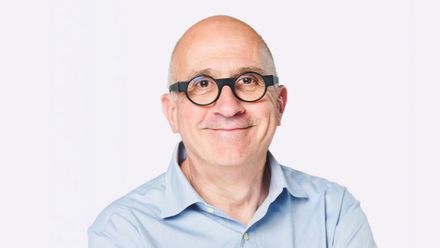
Paolo Meoni
Senior Distinguished Scientist and Project Head
For patients who have not found an adequate answer in existing single-target therapies – in autoimmunity, in cancer, in inflammatory disease – that designed complexity is where new options may come from.
The Trade-off Worth Making
DTL 2.0 is not a shortcut. In fact, it may even add time at the beginning, before a program enters the more familiar stages of drug discovery. Molecules need to be built, combinations screened, hits characterized, and mechanisms understood. Paolo acknowledges the trade-off. “More than accelerating the process, our dual-targeting approach gives us access to novelty,” he says.
That novelty, and the potential to make big gains for patients, is the reason to do this.
A combination identified through unbiased screening, acting through a mechanism no one predicted, is new biological knowledge. It may point toward a therapeutic direction that no one else has already converged on. “We are truly pursuing unknown areas of science,” Paolo says.
Generating Knowledge, Not Just Compounds
DTL 2.0 produces more than candidate molecules. It creates evidence about how pairs of targets behave together in ways scientists could not fully predict from studying each target in isolation.
For Paolo, this is what research is, at its core. “Science is a mode of inquiry more concerned about generating and testing hypotheses, than applying fixed knowledge,” he says. The unbiased, combination-seeking approach of DTL 2.0 creates opportunities for biology to answer questions that scientists may not yet know how to ask.
New therapeutic combinations, it turns out, are the kind of thing you cannot fully imagine. You have to find them.