The Fast (And Intense) Lane: How Expedited Approvals Are Going Further and Faster for Patients

During the race to contain the spread of the SARS-CoV-2 virus, the pace and nature of collaboration between the FDA and vaccine makers reached new heights. “It became obvious that the FDA’s division director, academia, other global health regulators and pharmaceutical R&D were all on the same side; fighting against a pandemic that was spreading like a wildfire,” noted Peggy Lipp, Sanofi’s Head of Global Regulatory Affairs and Chief Regulatory Officer. Facing intense pressure, regulatory agencies, scientists, biotech, and pharmaceutical companies collaborated to achieve fast vaccine development and approvals. People worldwide followed this race, and accelerated regulatory pathways became widely known.
Years later, we continue to debate how to balance faster patient access with thorough safety and efficacy data generation and reviews.
When there are diseases with urgent needs and no approved treatments, we advocate for opportunities to accelerate.

Peggy Lipp
Head of Global Regulatory Affairs and Chief Regulatory Officer, Sanofi
And new voices are joining these efforts. In a paradigm shift for our industry, the patient community is not simply advocating for expedited FDA pathways—they are now vigorously driving change, feeding into regulatory decisions, and mobilizing to demand prompt access to lifesaving therapies. Their efforts have become a powerful force, shaping policies and compelling the industry to respond to urgent medical needs. “Although pandemic-level speed is not feasible, many regulatory lessons learned from COVID-19 are being applied today”, Lipp says.
Disrupting the Status Quo: FDA Expedited Programs as a New Lifeline for Patients
After the years-long journey through the drug development process and clinical trials, a new treatment has a massive data set that companies submit to regulators for review. Most new therapeutics follow a standard review and approval process that relies on thorough evaluations of safety, efficacy and manufacturing quality that can typically take 10-12 months. The process brings together experts from diverse scientific backgrounds to assess distinct aspects of the therapeutic, evaluate clinical data, inspect manufacturing sites, and carry out thorough data analyses to reach a conclusion. New expedited pathways have been instituted by the FDA to reduce this review time to six months, or even less, meaning that approved therapeutics can get to patients sooner. In 2024, 33 of the 50 Center for Drug Evaluation and Research (CDER)’s novel drug approvals (66%) used one or more of these accelerated drug approval pathways, with the same number seen in 2025, as 33 of the 46 CDER’s novel drug approvals (72%) took advantage of these expedited programs.
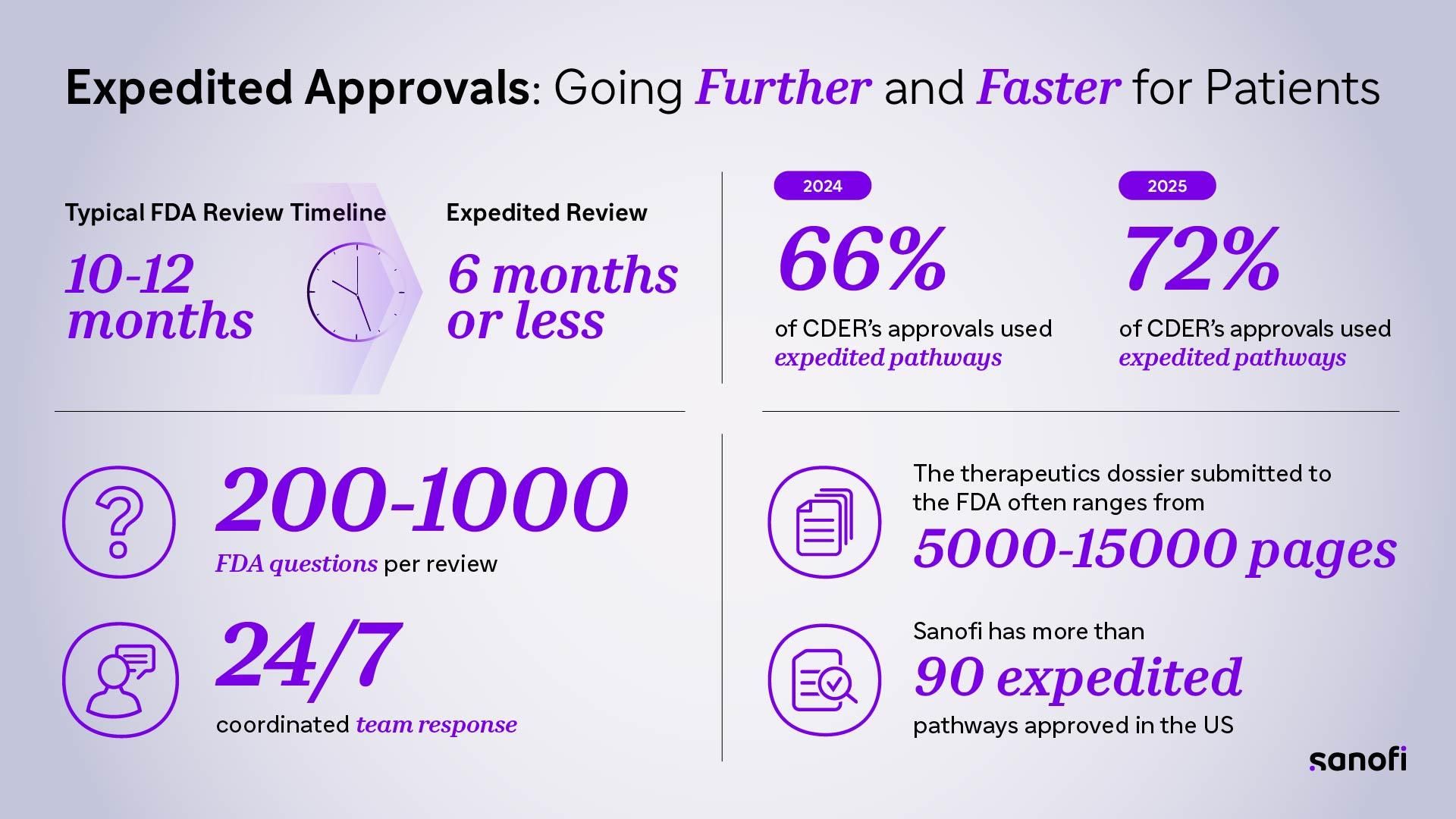
Accelerating access to critical medicines through expedited approval pathways require coordinated efforts to speed up timelines
It’s not just the urgent threat of infectious diseases that can warrant an expedited review. Cancers with no or limited effective therapies, rare diseases with few or no approved treatment options, neurological disorders with limited treatment options, and even drugs that provide better improvement compared to existing therapies may all warrant an accelerated approach.
Preparing for the Sprint: The Path to an Expedited Regulatory Review
Securing an expedited review requires careful preparation.
We begin with close collaboration and making a bold commitment to an all-hands-on-deck effort where entire teams rise to the occasion of these special reviews.
Peggy Lipp
Head of Global Regulatory Affairs and Chief Regulatory Officer, Sanofi
To access these expedited pathways, sponsors must provide extensive data and justification for why a therapeutic should be considered a priority. The FDA can also identify new therapeutics that they believe should be prioritized.
The Agency then reviews the application to determine if the therapeutic and respective indication(s) qualifies for an expedited pathway. Because of the significant workload that comes with this approach, explains Lipp, only a limited number of treatments are selected. Sponsors “have to prove that the effort the FDA is putting in can translate to real advantages to patients.” If the FDA agrees with the sponsor’s justification and data, an expedited pathway is granted, enabling faster review process, ultimately enabling patients to get the drug earlier than what would have otherwise been possible.
All Hands on Deck: The Intense, Rigorous Scrutiny of Expedited Regulatory Review
Once an expedited pathway is granted, the therapeutics dossier – a thorough collection of documents submitted to the FDA, often ranging from 5,000 -15,000 pages – undergoes intense scrutiny. Just like standard reviews, experts from the agency evaluate data across a treatment’s research and development journey, but at a quicker pace. From pharmacodynamics studies that look at how different doses of drugs are processed within the body, to pre-clinical data from cell lines, to manufacturing quality and control, to clinical trial results, a huge amount of information is evaluated in parallel, sparking questions that require rapid answers.
“We typically receive a minimum of 200 questions during the review,” Lipp says, noting that number can easily swell to 1,000 queries that the cross-functional team is committed to answering quickly. “As a part of the Commissioner's National Priority Voucher (CNPV) program, for example, we made a commitment to the FDA that our teams would work 24 hours a day, seven days a week.” And on that project, there was indeed a sprint: “We received questions at 11pm on Saturday and answers were due Sunday midday.”
Despite the quicker pace of evaluation, the FDA applies the same rigorous standards for demonstrating drug safety, quality and efficacy. The review process still brings together experts from diverse scientific backgrounds to assess distinct aspects of the therapeutic, evaluate clinical data, inspect manufacturing sites, and carry out thorough analyses to reach a conclusion.
The expedited approval, however, isn’t the end of safety and efficacy research – we are required to continue to monitor the drug usage to prove long-term clinical benefit for the drug to retain its approved status.
A Ripple Effect: Learning Lessons and a Focus on Efficiency
The challenges of expedited approvals have prompted Lipp and her team to reimagine our standard practices. With intense, rapid reviews, it’s critical to streamline data and think carefully about what really matters. Larger trials with more data points that require more patient participation, and resources may not serve patients well, while also slowing the review process. These considerations can also help focus clinical trial design for therapies that aren’t using expedited pathways.
We don’t want to unnecessarily burden patients and over-generate data. We must do everything we can to bring study size down and reduce the time it takes to bring new therapies to review.
Peggy Lipp
Head of Global Regulatory Affairs and Chief Regulatory Officer, Sanofi
In the future, Lipp hopes Sanofi will continue using AI-based modeling and simulation, leveraging digital twins and real world evidence to optimize our clinical trials and regulatory submissions.
Beyond individual trials or program design, Sanofi is taking a portfolio-level approach to accelerated drug approvals. Expedited pathways and special regulatory designations—such as Orphan Drug Designation or Regenerative Medicine Advanced Therapy Designation—are not pursued opportunistically, but deliberately, based on where they can meaningfully accelerate patient access. With more than 90 expedited pathways approved in the US and additional requests in preparation, this mindset is now embedded across development, ensuring that speed, science, and regulatory rigor are considered together—early and often.
The Regulator as a Partner
Lipp, a regulatory leader at Sanofi with nearly three decades of experience, underscores the importance of having agile, committed teams.
No two regulatory scenarios are the same. We need to be ready to learn, think and adapt quickly, to determine the strategy and bring the relevant experts to the discussion. The stakes are high – patients are waiting.
Peggy Lipp
Head of Global Regulatory Affairs and Chief Regulatory Officer, Sanofi
Lipp also finds that the regulator is an eager partner in these accelerated efforts. “The FDA is just as interested in getting innovative new therapeutics to patients faster, and is ready to collaborate to deliver results.” Choosing an expedited pathway is a conscious, strategic decision, describes Lipp. “It’s an intense, all-consuming effort for our teams. But for diseases where patients are counting every day, the extra work is why we’re here. This is a critical tool, and when the situation is right, it’s our obligation to use it to bring new hope to patients sooner.”