AI Across the R&D Value Chain: Portfolio Decision-Making

This article is the fourth and final instalment in our series on how we’re using AI to transform research and development across the value chain at Sanofi. In earlier parts, we explored AI’s impact on drug discovery, clinical development, and manufacturing and supply. Now, we turn to a crucial question: How can AI help us make smarter, faster, and more objective decisions about which programs to advance, accelerate, or stop?
From Molecule to Market: Smarter Choices with AI
Four years ago, Helen Merianos, SVP, Global Head of R&D Strategy & Portfolio Management, joined Sanofi to lead a transformation in portfolio management. “What attracted me was the opportunity to have an impact at a company-wide level and the alignment of senior leaders on the need for change,” says Merianos. “I’m amazed at the progress we’ve made in portfolio management by leveraging AI as a key accelerator.”
At Sanofi, we’re deploying machine learning (ML) and AI in R&D, from molecule design to writing clinical study reports. For example, AI is helping our scientists by supporting faster identification of the right targets, helping understand which targets are most relevant from a human biology perspective, and collaborating to efficiently design molecules in silico for specific targets. We’re also using AI and in silico (computer simulation) modeling before we take our investigational compounds into human trials to model their anticipated effect, which raises the likelihood of success in the clinic.
What attracted me was the opportunity to have an impact at a company-wide level and the alignment of senior leaders on the need for change. I’m amazed at the progress we’ve made in portfolio management by leveraging AI as a key accelerator.

Helen Merianos
SVP, Global Head of R&D Strategy & Portfolio Management
From Data to Decisions
Crucially, AI is central to our decision-making processes. Our industry-leading agentic AI app, ‘Plai’—developed with AI platform company Aily Labs—aggregates more than one billion data points across Sanofi. The tool predicts value drivers including R&D costs, clinical trial enrolment timelines, and a given program’s probability of success. It even talks, providing real-time and personalized “what if” scenarios that guide governance discussions.
Plai participates in all governance meetings, where molecule progression decisions are made. By combining feasibility insights with real-time learnings from global trial sites, AI helps sharpen study design and enables teams to ask smarter questions.
From Tool to Teammate
“It’s helpful to think of Plai as a new type of colleague,” Merianos explains.
“Imagine an empty chair at a decision-making table. That chair is occupied by a completely data-driven, objective perspective that can take new information and digest it in real time. It can digest the totality of data in a way a human cannot. You can debate it as you would a colleague. While not as sophisticated as a human, the AI agent adds diversity of thought and complements human perspectives.”
Plai is also helping with clinical trial enrolment, providing early warnings when recruitment slows and recommending adjustments. Recently, it guided pivotal phase 3 atopic dermatitis trials by forecasting study trajectories.
AI makes recommendations to optimize our portfolio, such as accelerating the strongest opportunities by taking into consideration unmet need and likelihood of success, while halting those with a lower probability of success or in areas with significant competition that would make differentiation difficult.
“We’re using AI at every investment and progression opportunity across the value chain from a decision-making perspective,” says Merianos.
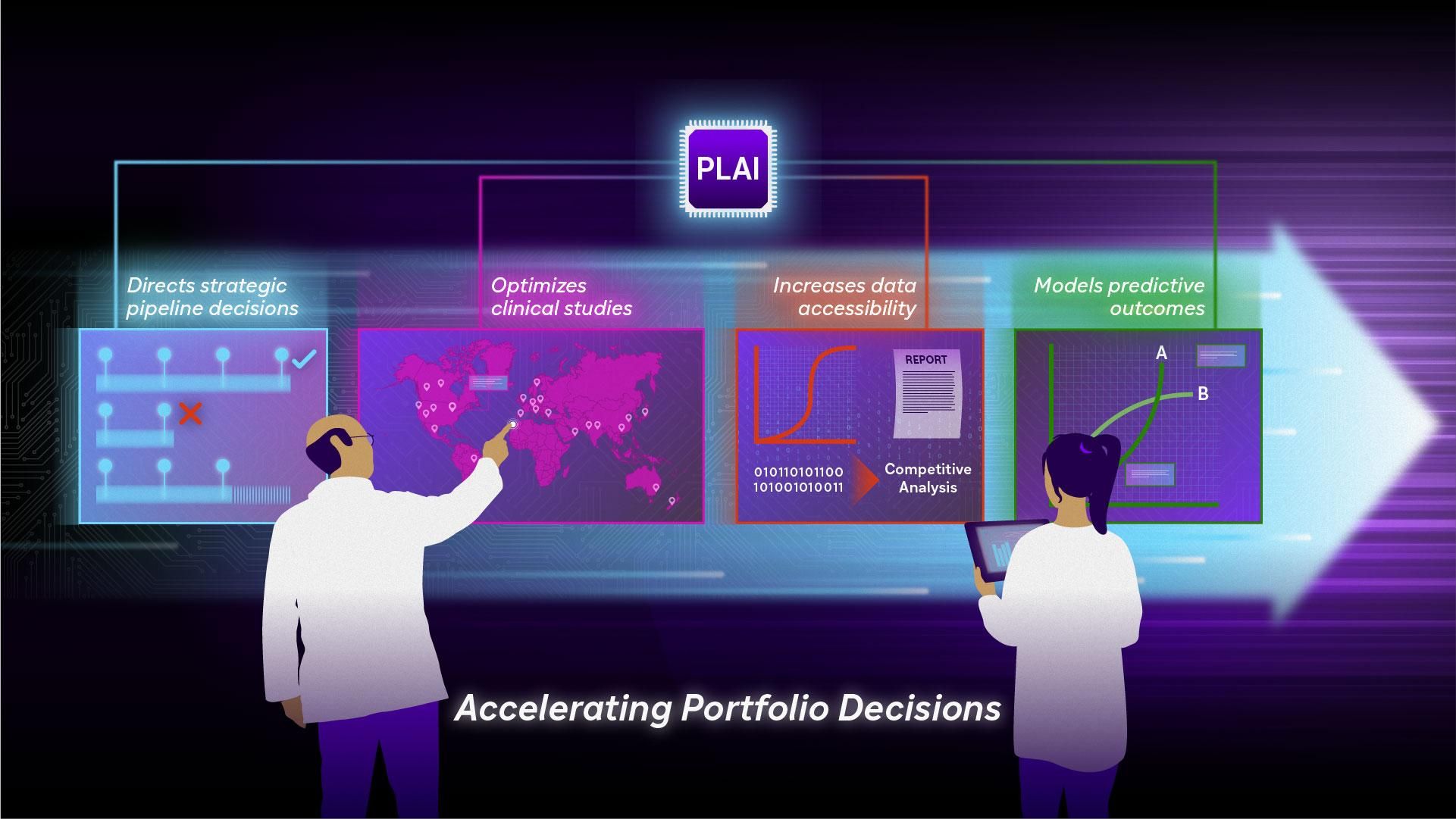
Sanofi's AI agent 'Plai' synthesizes complex R&D data streams to enable faster, smarter portfolio decisions.
Democratizing Insights
Another advantage of Plai is that it’s accessible across the company, enabling project teams and decision makers to access numerous AI agents.
What sets Sanofi apart is not the tool itself, but its end-to-end use of AI. And by improving the quality of inputs at each stage, AI has become a true competitive advantage. It has driven a cultural change and transformed business processes.
“We’re taking a broad and deep approach in areas that we believe matter the most, like using AI to improve our probability of success predictions,” Merianos clarifies. “Many other companies are not yet using AI and AI agents the way we are in governance across the portfolio at the scale we are deploying it. We’re leveraging AI to improve the quality of all inputs at the decision-making stages for each decision.”
Partnership, People, and Policies
Strategic partnerships amplify this impact. One example is our collaboration with McLaren Racing. Our R&D teams are learning how McLaren Racing is applying AI models and data to drive strategic, more impactful decision-making.
“McLaren Racing is very clear on who has the ‘D’ in decisions,” Merianos notes. “That clarity on accountability to drive decisions has been a key learning for us.”
But technology alone is not enough. Change management remains one of the biggest challenges. “AI is not perfect, and it’s only as good as the data it’s trained on,” Merianos emphasizes. “That’s why we have an organizational policy for responsible AI use, with humans always in the loop.”
It’s a balance. Even if the AI isn’t 100% right, it still makes us smarter. But without human perspectives, governance committees may lose trust. Real people remain essential to interpret nuance, recognize blind spots, and ensure confidence.
Helen Merianos
SVP, Global Head of R&D Strategy & Portfolio Management
Elevating the Conversation
Far from replacing people, AI is transforming the nature of how we work. Most importantly, AI has elevated the quality of conversations at Sanofi. "When I first started at Sanofi, R&D discussions focused on validating data inputs. Now, with automation handling the inputs, we can focus more on strategy and forward-looking conversations. AI has driven a significant cultural change at Sanofi and raised the level of dialogue in R&D decision-making,” Merianos concludes. “AI will shift how people spend their time at work, toward more value-added, rewarding, and intellectually stimulating activities.”
Conclusion
This four-part series has taken us through Sanofi's R&D value chain, illuminating where AI is transforming how we think and act: from the initial spark of drug discovery and arduous adventure of clinical development to the efficiency gains in manufacturing and supply, to the strategic decisions that shape our pipeline. AI is not just a tool, but a transformative force, accelerating timelines, enhancing precision, and ultimately, bringing life-changing medicines to patients faster. As we look to the future, Sanofi remains committed to pushing the boundaries of what's possible, leveraging the power of AI to redefine healthcare and deliver on our promise to patients worldwide.